Getting Your Financial Ducks In A Row Rotating Header Image

social security

3 things you can do if you’ve filed for Social Security benefits too early

It's too early for the beach

It’s too early for the beach (Photo credit: c@rljones)

I often hear from people who, for whatever reason, decided to file for their Social Security retirement benefit immediately upon reaching 62 (or 66, or whatever age), and now they have found out that this wasn’t necessarily the best option for them to maximize their lifetime Social Security benefits.

There are several things that you can do about this – three that come to mind at the moment.  Below we’ll work through each of these ways to fix a situation where you filed too soon.

Pay it back

If it’s been less than 12 months since you filed, it’s possible for you to withdraw your application for benefits and pay back all that you’ve received to date.  Once you’ve done this, as far as Social Security is concerned, you never filed.  All of your benefit options are intact, just as if you hadn’t filed in the first place.

If your spouse or other beneficiaries began receiving benefits based on your record when you filed for your own benefit, those benefits will cease, and all benefits that your spouse or beneficiaries have received to date will also have to be paid back.

This can be quite costly to do, but the increased future benefits are likely worth the cost.

Work it off

If it’s been more than 12 months since you filed or if the cost to pay it all back is just too much to stomach, there’s another way to sort of re-set your options.  This method isn’t as good as the payback option, but it’s the next best available to fix your problem if you are still working (or can get a job) and you’re younger than Full Retirement Age (FRA).

Here’s how it works:  if you are under FRA and working while receiving Social Security benefits, for each two dollars above a certain limit ($15,120 in 2013 and adjusted each year) one dollar of benefits will be withheld.  For example, if you are receiving $12,000 per year in Social Security benefits and you get a job that pays you $25,000 a year, $4,940 of your benefits will be withheld.  Since you’re receiving $1,000 per month in benefits, this means that 5 months per year will be withheld.

Once you reach FRA (where the earnings limit no longer applies) if you have earned that extra amount for four years (thereby giving up 20 months’ worth of benefits) your benefit will be adjusted.  The adjustment makes your benefit reduction appear as if you filed 20 months later than when you actually did.  So if you originally filed at exactly age 62, your benefit would be reset at FRA as if you filed at age 63 and 8 months.  This would have the effect of increasing your benefit by 9.44%.

If you earned enough in your job to eliminate all of your Social Security benefits between age 62 and 66, you would effectively re-set your benefit as if you had delayed filing until age 66.

During the year that you will reach FRA, the earnings limit is different, and it’s applied differently as well.  You can earn as much as $40,080 for the year, and each three dollars above that limit will reduce your benefit by one dollar.

It’s important to note that these earnings must be active earnings, such as from a regular job or self-employment.  Withdrawals from an IRA, while taxable, are not counted toward the earnings limit and can’t be used to reset your benefits.

Suspend

Although most of the time the concept of suspending your benefit is discussed as a part of the “file & suspend” tactic, where you file and then immediately suspend receiving benefits in one action, you are allowed to suspend your benefits at or after FRA regardless of when you originally filed.  So, if you filed for your Social Security retirement benefit early and you decided that it was a mistake, when you reach FRA you have the option of suspending your benefit and allowing the delay credits to accrue on your record.

For example, if you filed at age 63 and collected benefits until you reached FRA at age 66, you could suspend your benefits at that point.  If you were receiving a $1,000 benefit from filing at age 63, this was 80% of your PIA, which would have been $1,250.  If you suspend at FRA and then re-file at age 70, then your delay credits would be 32% – which would bring your total benefit up to 112% of your PIA, for a new benefit of $1,400.

While your benefit is suspended your spouse and/or beneficiaries will continue to receive their benefits based on your record just the same as if you were actually collecting the benefits (subject to the family maximum).  The delay credits, once earned, will not have an effect on those benefits that they’re receiving while you’re alive, but the delay credits will be applied to any survivor benefits that they receive after your passing.

The Combo

You could use the Suspend option in tandem with the Work it off strategy:  by earning above the limit each year you’re improving the benefit that you’re eligible for at FRA – and then when you get to FRA you can suspend your benefits to further increase your benefit.

In addition to the above options, if none of them will fit your needs (such as if you don’t have another source of funds to get you by while you suspend and delay), if your spouse has not yet filed you can delay your spouse’s benefits as long as possible in order to maximize that benefit.  Of course, this is to assume that your spouse hasn’t already filed too.  There are several strategies that could help you to maximize benefits in that case, including filing a restricted application once he or she reaches FRA.

Enhanced by Zemanta

Family Maximum and File & Suspend

Radio Maximum logo

Radio Maximum logo (Photo credit: Wikipedia)

I recently received the following email from a reader:

I am 66 and my wife is 45, and our son is 12.  I intend to delay my filing for Social Security benefits until age 70 in order to provide the highest survivor benefit for my wife since I’m so much older than her.  But I also realize that my wife and son may be eligible for benefits now if I file and suspend.  According to my SSA statement my benefit now at age 66 is $2,576.  Since my wife and young son are eligible for 50% of my benefit (after I file and suspend), each should receive $1,288, right?  When I talked to the SSA office, they told me that their benefits would be limited by the family maximum benefit, which is $4,323, and they would only receive $873.70 each.  I can’t make the numbers work out, are they telling me wrong?

Unfortunately for the above situation, SSA was correct in the calculations – because of how the family maximum benefit and file & suspend work together.

Recall that the family maximum benefit limits all other dependent benefits paid on an individual’s record after the individual’s own PIA is subtracted from the family max figure.  Regardless of whether the worker is currently receiving his or her own benefit, the PIA is subtracted from the family maximum benefit amount before calculating all other benefits on that record.

So in the case of the reader who emailed me, when his PIA of $2,576 is subtracted from his family maximum benefit of $4,323, there is a remainder of $1,747.  This is all that’s left for dependent benefits, and it’s split evenly among the wife caring for the child under age 16, and the child who is under age 18.  In this case, when the child reaches age 16, his mother’s benefit will go away, and he will be eligible for the full $1,288 (adjusted for COLAs and any changes to the father’s PIA from additional work on his record).  The child will receive that benefit until he reaches age 18.

It’s important to note that if the father passes away before the child reaches age 18, the family maximum benefit will still apply, but there will be changes to the benefits received.  First of all, if the father died before the child reached age 16, the mother and child would each be eligible for a 75% benefit based on the father’s projected benefit at his attained age as of his death.  This benefit would be subject to family maximum benefit rules, but since there are only two of them, their combined benefit is still less than the max, so there is no limit and each would receive $1,932 (adjusted for COLAs and delay credits).

After the son reaches age 16, again his mom’s benefit would be eliminated and he would continue to receive the full 75% benefit.

If the original emailer from above had an ex-spouse who would be eligible for benefits (either spousal or survivor’s, depending on the situation) these benefits would NOT reduce the family maximum benefit available to the emailer’s current spouse and child.  Plus, the family max calculation does not apply in any way to the ex-spouse’s benefits.

Enhanced by Zemanta

Book Review: How to Retire Happy

How to Retire Happy

“The 12 most important decisions you must make before you retire”

Author Stan Hinden, who is the former syndicated Washington Post “Retirement Journal” columnist, has just released his Fourth Edition of this book.  The book is Hinden’s commentary and advice, as well as a sort of journal, as he and his wife Sara entered into and have been living in retirement over the past 17 years.  Hinden retired in 1996 at the age of 69, at which time he began writing the “Retirement Journal” column.  He was nominated for a Pulitzer Prize in Commentary in 1998 for his work.

This book is an excellent read for folks who are planning toward retirement or have recently retired.  Hinden has organized the process into 12 decisions, some of which include: “Am I Ready to Retire?”, “What Should I Do with the Money in My Company Savings Plan?”, and “Where Do I Want to Live When I Retire?”. Mr. Hinden then walks through each of the 12 decisions with his own personal insights and choices, as well as with expert recommendations and commentary on the subjects.

The book is a fairly quick read at 250 pages, and the writing style is simple and conversational.  The decision-points that Mr. Hinden discusses are thought-provoking, and he has been diligent to provide sources for additional review at the end of each Decision/Chapter.  Topics covered include income taxes, pensions, retirement accounts, Social Security, Medicare, long-term care insurance, and many other categories pertinent to retirees.

The author’s wife, Sara, became afflicted by Alzheimer’s Disease in 2007, which has resulted her needing to be placed in a residential nursing facility as the disease has progressed.  This was a particularly difficult section for me as I very much empathized with Mr. Hinden as he was faced with the difficult decisions associated with his wife’s condition.  In a similar fashion, the author discusses the issues that he faced with his own health after learning that he needed a four-way heart bypass shortly after his retirement.  These insights that are brought forth are very helpful though, as we all must consider that such decisions may likely be a big part of our own lives.

I will recommend this book to any and all folks who are looking for insights as they approach retirement.  It will definitely give you additional insight as you take on this next step in your life – what Hinden mentions is likely the “final quarter” of your life.  He points out though, that this final quarter needn’t “sound grim.  In any football game, the last quarter is often the most exciting.  The same can be true of retirement.  It is one more chance to add points on the scoreboard of your life.”

The above book review is part of a series of reviews that I am doing in an arrangement with McGraw-Hill Professional Publishing, where MH sends me books with the only requirement being that I read the book and write a review – like it or not.  If you find the information in this review useful, let me (and McGraw-Hill) know!

Another “Swim with Jim” Interview on Social Security

English: A scene from the U.S. Social Security...

I recently once again was honored to be interviewed on the radio by Mr. Jim Ludwick.  Jim is a CERTIFIED FINANCIAL PLANNERTM professional, and his practice is based in Odenton, Maryland with additional offices in Washington, DC, Santa Barbara, California, San Mateo, California, and New York City.  Jim also is a fellow member of the Garrett Planning Network.

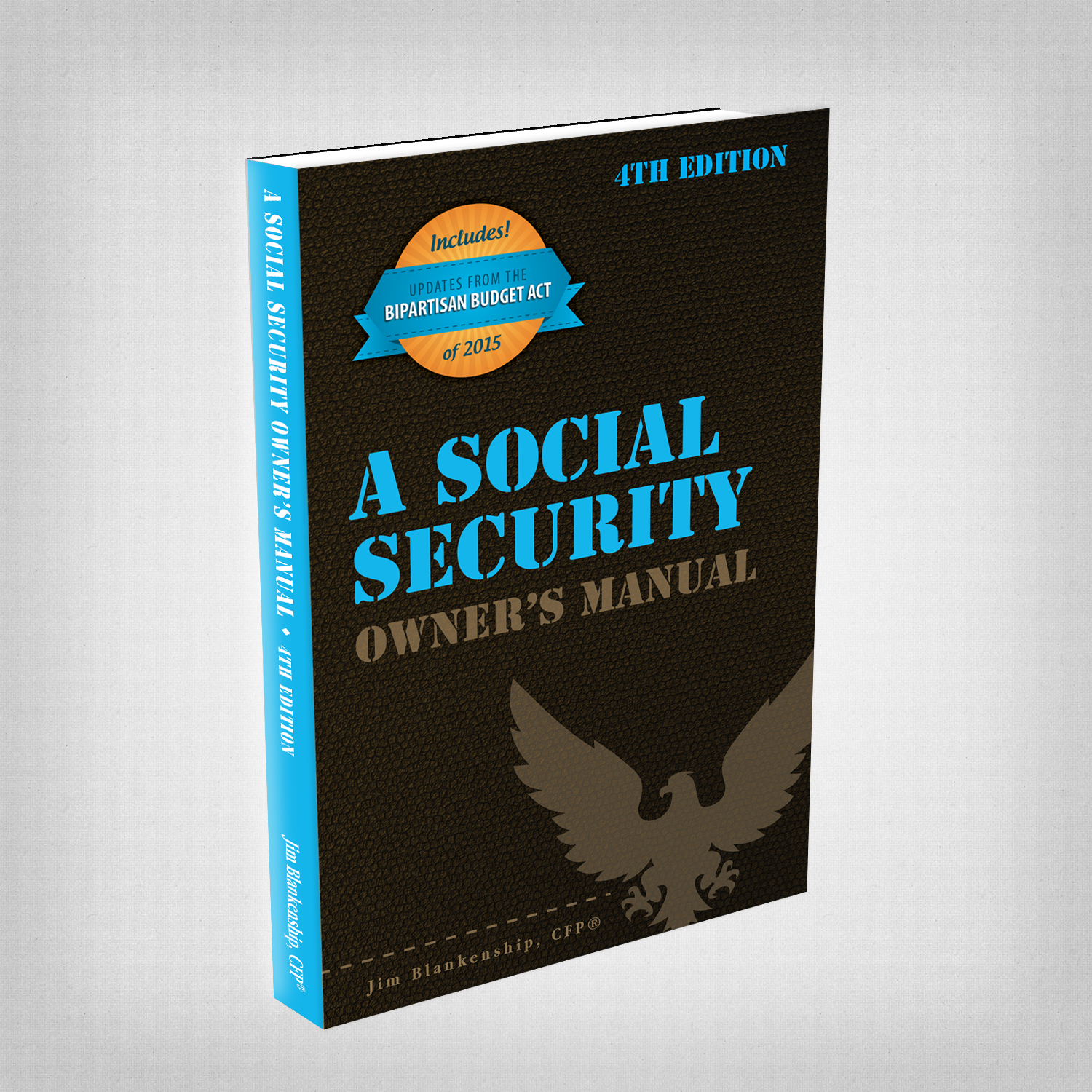
We discussed the recent new edition of my book, A Social Security Owner’s Manual, 2013 Edition, and the new information that has been provided there.  We also reviewed some of the reasons that the Social Security benefits calculation process is so complex, as well as the concept that, in many cases, it can be more efficient to use IRA resources to help you get by until your Social Security benefits can be maximized.

I reviewed a case like this recently in an article at credit.com, entitled My Smartest Money Move: Taking More From My IRA.  In that case, a retiree saved a boatload in interest and taxes by using his IRA in the early years, maximizing the amount of future income he’ll receive in Social Security benefits.

You can follow Jim’s radio program on BlogTalkRadio; his channel is Swim With Jim.  The specific recent episode where I was interview is called Social Security Answer Man.

Enhanced by Zemanta

Computing Your Social Security Monthly Benefit

Calculator

When planning for Social Security retirement benefits, it is important to know how to compute the amount of your benefit at various ages.  The amount of your benefit will be different depending upon your age when you begin drawing the benefit, as well as your record of earnings over time.

Below are the factors that are needed in order to determine the amount of your Social Security benefit:

  • Your Primary Insurance Amount, or PIA
  • Your Full Retirement Age, or FRA, which is determined by your year of birth
  • Your age when you will begin drawing benefits
  • Whether or not the Windfall Elimination Provision (WEP) applies to your benefits

This earlier article has information about the PIA, and you can find your PIA on your Social Security statement.  Your FRA, if you were born between 1943 and 1954, is 66.  If you were born in 1955 or after, FRA gradually increases up to 67 by birth year of 1960 or later.

So with these first two factors, we can construct the initial part of the monthly benefit equation.  If you begin receiving benefits in the month that you reach FRA, your benefit is equal to your PIA (although this could be reduced by WEP if it applies, see below).  If you are intending to begin benefits before FRA, there will be a reduction from your PIA.  On the other hand, if you begin benefits after FRA, the amount of your benefit will be increased from your PIA.

Prior to FRA

If starting to receive benefits prior to FRA, you need to calculate the number of months prior to FRA that you’ll begin.  If it’s less than 36 months prior to FRA, take the number of months times 5/9 of a percent.  This will give you the amount of reduction.  For example, if you were starting your benefit 24 months before FRA, the calculation is:

24 * 5/9% = 120/9% = 13 3/9%, or 13.333%

If, on the other hand, you are starting your benefit more than 36 months prior to FRA, the calculation becomes more complicated.  For every month greater than 36 prior to FRA, you multiply by 5/12 of a percent, and then add 20% (36 * 5/9%) to that figure to come up with the total reduction.  So, for example, if you were starting your benefit 43 months before FRA, the calculation goes as follows:

43 minus 36 = 7

7 * 5/12% = 35/12% = 2 11/12%, or 2.9167%

20% plus 2.9167% = 22.9167%

Both of these factors are reductions, so you will subtract the factor from 100%, and multiply this by your PIA to come up with your monthly benefit amount.  From the first example, if your PIA was $2,000, the reduced benefit amount would work out to $1,733, since 100% minus 13.333% equals 86.667%.  Multiplying $2,000 by 86.667% equals $1,733.

For the second example, again using a $2,000 PIA, your benefit would be calculated as follows: 100% minus 22.9167% equals 77.0833%, times $2,000 equals $1,542.

This is your monthly benefit amount if you start benefits before FRA and the WEP doesn’t apply.  If the WEP applies to you, skip down to the section on the Windfall Elimination Provision.

After FRA

Much like the calculation for starting benefits before FRA, the calculation for starting benefits after FRA is based upon the number of months relative to FRA.  So you need to figure out how many months after FRA you are intending to begin your benefit.  For each month after FRA to the start of your benefits, up to age 70, your benefit is increased by 2/3 of a percent from your PIA. (This factor has been different in past years, but for now this is the applicable figure.)

If you wait until two and a half years after FRA to begin your benefits, this is equal to 30 months.  So the calculation for the increase is as follows:

30 * 2/3% = 60/3% = 20%

Since this is an increase over PIA, add the factor to 100%, and multiply by your PIA to come up with the monthly benefit amount.  From our example earlier, your PIA is $2,000, and you have delayed 30 months (2 1/2 years) after FRA to begin your benefit.  Multiply $2,000 by 120%, and you come up with a benefit amount of $2,400.

This is your monthly benefit amount if you have delayed receiving your benefit after FRA, unless the Windfall Elimination Provision (WEP) applies.  Keep reading for how the WEP can impact your benefit.

Windfall Elimination Provision (WEP)

If you are (or will be) receiving a pension from a job that was not covered by Social Security (e.g., a government job or a job overseas), the Windfall Elimination Provision, or WEP, will further reduce your monthly benefit amount.  See the article at the link for how the Windfall Elimination Provision is calculated.

What is important to know is that the maximum amount that the WEP can reduce your benefit (for 2013) is $395.  So if the WEP impacts you to the maximum extent, your monthly benefit amount that we calculated earlier will be reduced by $395 in 2013 – and this figure is adjusted annually by the normal Cost-of-Living Adjustments (COLAs) that are applied each year.  See this article (at the link) for information on how the WEP can be reduced or eliminated.

So that’s it – follow the above steps and you have a good idea of what your monthly benefit amount will be.  Happy calculating!

Enhanced by Zemanta

Restricted Application is Available via the Online Application

I learn something new almost every day.

Today (well, not today but recently), I learned something about the online application for Social Security that I didn’t know: the restricted application for Spousal Benefits is available as a choice when you apply using the online application system! (If you want more information on why a restricted application is important, see this article about Leaving Money on the Table.)

For quite a while now I’ve been telling folks that the best way to apply for the restricted application is to go to your local office.  When you get there and explain that you want to submit a restricted application for Spousal Benefits only, the first person that you talk to will likely tell you that you can’t do this, because your own retirement benefit is greater than half of your spouse’s PIA, or something like that.  Then my advice has been to ask for a supervisor and explain it again, and keep insisting that you’re eligible to do this (make sure that you are, first of course!), until you get the right person to agree with you.

As it turns out, for some time now you’ve been able to select this option via that online application.  See below – this is a screenshot of the application system (sorry it’s not very legible).  The last part in bold says:

If you are eligible for both retirement benefits and spouse’s benefits, do you want to delay receipt of retirement benefits?

bene app screenshot restricted app

It’s clear that this option gives you the ability to delay the receipt of your retirement benefit and only receive the spouse’s benefit, assuming that you’re at least at Full Retirement Age and your spouse has applied for his or her benefit.

This is great news – since now you won’t have to go through the hassle described above in order to submit a restricted application for spousal benefits.

An additional, likely unintended positive to this development is that you could use this blog to show the first person you talk to (if you still opt to visit the local office) in order to help prove your eligibility for this option.

Social Security Benefits and Taxes

Backcountry Provisions

When you’re receiving Social Security benefits, you may be subject to income tax on those benefits.  At the end of the year, you’ll receive a form SSA-1099 from the government that details the benefits that you’ve been paid, as well as the amount that has been deducted for Medicare premiums, and any federal income tax that you’ve had withheld from the benefit checks.

When you prepare your tax return for the year, if you’re using a software program (does anyone prepare them by hand any more?), the program will give you a place to enter the figures from your SSA-1099 form.  Then after you’ve entered all of your other income information into the system, it will calculate how much of your Social Security benefit is subject to income tax.

But that’s no fun, is it?  How do you know how much of your benefit is going to be taxable?

Here’s how it works: there is a figure known as provisional income, which is calculated using all of your other income (including tax-exempt interest) plus half of your Social Security income.  Your provisional income is then compared to a base amount, depending upon your filing status.

  • For filing status of Single, Head of Household, Qualifying Widow(er) with a Dependent Child, or Married Filing Separately (if you did not live with your spouse at any time in the year), the base amount is $25,000
  • Married Filing Jointly, the base amount is $32,000
  • Married Filing Separately (if the spouses lived together at any time during the year), the base amount is $0

If your provisional income is above the base amount for your filing status, your Social Security benefit at least a portion of your benefit is going to be taxable.  Up to 50% of your benefit may be taxable as ordinary income, until you reach the next base level.  If your provisional income is greater than the first base level but less than the next base level, at most 50% of the Social Security benefit will be taxable.  The next base levels are:

  • $34,000 (Single, Head of Household, etc.)
  • $44,000 (Married Filing Jointly)
  • $0 (Married Filing Separately)

When your provisional income is greater than the second base level, a portion of your Social Security benefit will become 85% taxable.  Upon reaching the second level, a portion of the benefit is 50% taxable and the amounts above the second level are 85% taxable.  As your income increases, eventually all of your Social Security benefits become 85% taxable.

If you want more detail on the calculations, you can look at this earlier article which works through the calculations for Social Security benefit taxation.  It gets pretty complicated, but it’s useful to know how it all works, in case you can change your income to make a difference in how the benefits are taxed.  This is also useful as you plan which types of income to recognize – if you can take Roth-type income versus regular IRA income,it can have a profound effect on the taxation of your Social Security benefits.  For more on how this works, see this article on Roth Conversions and Social Security benefits.

Enhanced by Zemanta

Notify Social Security of Major Changes in Your Life

Change happens

You know how, after you’ve put your kids through college and they go off on their own, sometimes you don’t hear from them as often as you’d like?  Major things occur in your kids’ lives and you don’t know about them until after the fact, possibly long after.  So you get onto them about it, and ask the kids to call more often (or you call them more often) so that you can keep up with what’s going on…

It’s kinda like that with the Social Security.  They want to know when major changes occur in your life, as soon as possible.  This is primarily due to the fact that, quite often, these changes will result in adjustment to your Social Security benefits.

The first one that comes to mind is the death of a Social Security recipient.  Naturally you need to notify the Social Security Administration as soon as possible upon the death of a recipient.  The benefit that the deceased recipient was receiving might transfer to his or her spouse if the rules allow.  Otherwise, the benefit will cease for that recipient, and other benefits may begin for dependents of the recently deceased.

If you are receiving Social Security benefits and you get married (or re-marry, either after the death of a spouse or after a divorce), it’s important to let the SSA know about your change of marital status.  This is because your marital status may have an impact on any benefits that you are receiving that are based on a former spouse’s record.  In addition, a new marriage could result in new dependents for you, and so your new dependents could be eligible for benefits based on your record.

In addition to death and marriage, SSA also wants to know if you are earning more than the allowable limits if you’re less than Full Retirement Age.  This is because a portion of your benefit will be withheld due to the additional earnings.  You can’t escape it, they’ll eventually figure this out and possibly ask for repayment.  Plus, if you’re receiving a pension from a non-SS covered job, you need to let SSA know about it so that your benefit is adjusted for WEP or GPO if either of those factors apply to your situation.

Obviously you need to let SSA know if your name or address changes and if your direct deposit account changes – you need to make sure that you will continue to receive your benefits and that important notices make them to you in the mail.

If your change of address includes an extended stay outside of the United States, you need to let SSA know about it.  You should also know that there are some countries that Social Security can’t send payments to – Cambodia, Cuba, North Korea and Vietnam.  Otherwise, you can have payments sent to you if you’re living in another country, but you’ll need to arrange this with Social Security.

Enhanced by Zemanta

Know Your Options When Talking to Social Security

Cardpunch operations at U.S. Social Security Administration

When you get ready to file for your retirement benefits, it’s important to understand what options are available to you before you talk to the Social Security Administration.  There are many ways to get a good understanding of your options, including working with your financial advisor, reading up on the subject (this blog is a good place to start!), and talking to friends and relatives who have already gone through the process.

The reason it’s important to know your options is because the Social Security Administration staff that you may encounter are not trained to help you maximize your lifetime benefits – they are trained to help you maximize the benefit that you have available to you today.  Often the options that the SSA staff present to you are not the best options for you in the long run.  In addition, SSA staff are absolutely overwhelmed by the volume of folks that they are in contact with.  As I understand it, disability claims are backlogged by as much as three years in some cases – so you can imagine how difficult it is for the staff to handle new, unusual cases.

Listed below are a few examples that I’ve heard recently where folks have gotten erroneous or incomplete responses to basic questions presented to SSA staff.  This is not intended to be an exhaustive list, just a few things I’ve heard about recently.

Restricted Application

An husband, age 66, wishes to delay his filing to age 70.  At the same time, his wife, age 62, is filing for her own benefit today.  The husband wishes to file a restricted application for spousal benefits only – which would allow him to receive a benefit equal to half of his wife’s PIA (not her reduced benefit) while he continues to delay his own benefit to age 70.  SSA staff told him that since his own benefit would be greater than half of his wife’s PIA, he would not be able to do this.

Of course, if you’ve read this blog or my book, you know that this is incorrect.  The man called me and asked about it – and I told him to go back to the SSA and make the request again, specifically requesting to file a “restricted application for spousal benefits only”.  I then recommended that if he still received a negative response to request to speak to a supervisor about it.  Eventually, with this guidance, he was able to get the benefit that he asked for.

“Bonus” Lump Sum

If you are over Full Retirement Age (age 66 these days) and you go to or call the Social Security Administration to file for retirement benefits, you may be presented with an option for a “bonus” lump sum of up to six months’ worth of benefits, to be paid to you when you receive your first check.  Don’t fall for it without knowing what’s going on!

What is happening is that the SSA staff is suggesting an option to you that is available – of retroactively applying for benefits six months prior to the actual date.  Effectively, if you are (for example) 67 years old when you take this option, you will be filing as if you are 66 years, 6 months of age.  This will reduce your Delayed Retirement Credits by that 6 months, or 4%.  You’ll end up with a lump sum check for the six months that you hadn’t received up to that point, but your future benefits will be 4% less than they would have been had you filed at your attained age of 67.

If this is what you want, then go for it – but realize that not only is your own future benefit going to be permanently reduced from what it could have been, any survivor benefits that your spouse will receive are also reduced.

Divorcee planning

A divorced person who is qualified to receive benefits based upon her ex’s work record often has difficulty in planning when to receive benefits.  This is especially troublesome if you are pretty certain that your Spousal Benefit will be significantly more than your own benefit, and you’d like to maximize that benefit.  The trouble is that you may not have access to the complete information about your ex’s benefit (and therefore, any spousal benefit you could receive).

The key to this is to have the correct documentation about your situation when you talk to Social Security.  Most often, this is going to require a visit to the local office, although I’ve been told this can be done over the phone.  I assume in a case like that there are several calls involved because you’ll have to send your documentation for the SSA to verify.

At any rate, if you have your marriage license and your divorce paperwork, which show that you were married for ten or more years and the divorce occurred more than two years ago, along with your ex’s Social Security number and date of birth, the SSA staff will be able to provide you with information about what benefits you are eligible to receive based on the ex’s record.  Without this documentation, you will be denied access to the information.

Enhanced by Zemanta

How to Reduce or Eliminate Windfall Elimination Provision Impact to Your Social Security Benefit

Basic WEP encryption mechanism

In prior articles we have discussed the Windfall Elimination Provision (WEP) which has the effect of reducing a portion of your Social Security retirement benefit if you’ve worked in a job that was not covered by Social Security which also provides a pension.  This article deals with two ways that you can remove the impact of the WEP from your benefit – neither of which is simple, and neither of which can be done after you’ve retired.

The two methods are:

  1. Add years of “substantial earnings” to your record
  2. Take a lump sum distribution from your pension before you are eligible to receive the pension.

Adding Substantial Earnings Years

If you have the opportunity to work in a job that is covered by Social Security withholding and you have “substantial earnings” from that job, each year that you work in this SS-covered job adds to your ability to begin eliminating the WEP impact.

This is not an insignificant undertaking.  Substantial earnings for 2013 is defined as $21,075 or more in earnings covered by Social Security, and this figure is adjusted annually by the Cost-of-Living increases.  Plus, it doesn’t make a difference on your WEP impact until you’ve added 21 or more years of substantial covered earnings to your record.

The good news is that if you have 30 or more years of substantial earnings in a Social Security-covered job, you’ll eliminate the WEP impact altogether.

Taking a Lump Sum Distribution of Your Pension

If you don’t have enough years with substantial earnings, there is another way that you can eliminate the impact of WEP, which again isn’t an insignificant thing to do.  If you have the ability to take a lump-sum distribution of your non-covered pension before you are eligible to receive the pension, you can eliminate WEP impact altogether.  By doing this you’ll forfeit any future pension that you might have received from the non-covered employer.

The timing on this has to be right – if you are eligible for the pension when you take the lump sum distribution, you’ll still have WEP impact.

For example, John is a teacher in a state in which teachers are not covered by Social Security and he works there long enough to build up a pension.  He decides to leave that state and go to another state where teachers are covered by Social Security.  He’s young enough that he is not yet eligible for the pension in the first state.  If he withdraws the entire pension from the first state and thereby forfeits all future claim to that pension, he will no longer have future WEP impact on his Social Security.  That is, unless he goes back to another non-Social-Security-covered job at a later point in his life.

Important points

It’s important to note that WEP impact only occurs if the pension is considered to be the primary retirement plan.  This is regardless of whether the pension is funded by the employee only, by a combination of employer and employee contributions, or solely by the employer.

If the plan is considered to be a supplemental plan (for example, as a 403(b) plan might be to a regular pension plan), then if the source of funds is solely from the employee, this plan will not produce a WEP impact.  In a case like this, the primary plan would likely produce the WEP impact anyhow, unless one of the options listed above is used to eliminate the impact.

In addition, payments from optional savings plans, such as the TSP (Thrift Savings Plan) for CSRS employees, are not considered as WEP-impacting pension payments.

If there are multiple sources of pension from the non-covered employer, only the applicable pension for WEP impact is considered when calculating the maximum WEP impact. This is because WEP impact can’t be more than 1/2 of the applicable pension amount.

Enhanced by Zemanta
%d bloggers like this: