

Photo credit: diedoe
As an owner of an IRA or other qualified retirement plan (such as a 401k), when you reach age 72 (or 70½ under the pre-2020 rules) you are required to begin taking distributions from the account(s). There are several important factors about these distributions that could trip you up if you’re not careful. Listed below are some of the more important rules – but keep in mind that these RMD rules are only for the original owner of the account, not for a beneficiary of an inherited account. There is a different set of rules for inherited IRA RMDs.
Required Minimum Distribution Rules
Calculation of RMD –
- Determine your account balance from the end of the calendar year prior to the year for which the distribution is being calculated. Any additions or withdrawals after December 31 of the previous year are not included in this balance, even if an addition is for the previous calendar year. Also, any “in flight” rollovers or recharacterizations that effectively would impact the end of year balance are included (or excluded) in the balance as applicable.
- You must learn your distribution period, which can be found in Table III, using your age at the end of the current year (not the previous year).
- Divide the balance determined in #1 by the distribution period found in #2. This is your RMD for the current year.
- For each subsequent year, go back through #1 for a new balance at the end of the prior year, then go to the table from #2 to get a new distribution period, and do the math.
More Than Minimum – for any year in which you withdraw more than the RMD amount you are NOT allowed a credit against future year RMD. The result is that your balance at the end of the current year would be less, so future RMD would be less as well, but not by the amount of your extra withdrawal in the previous year.
No Rollovers or Conversions of RMD Amounts – Although you’re allowed to rollover or convert IRA funds after age 72, you cannot rollover or convert the amount attributable to your RMD for the year. This amount (the RMD) must be taken completely out of tax-deferred accounts.
Multiple Accounts – For the purposes of calculating RMD, the IRS considers all traditional IRAs owned by one individual as one aggregate IRA. This means that you can determine your RMD by adding together the balances of all your traditional (non-Roth) IRA accounts at the end of the prior year, and then taking your RMD from any one account (or as many accounts as you wish) as long as it totals at least the RMD for that year. Other qualified retirement plans such as a 401(k) must be treated separately – that is, RMD must be calculated only on that account and distribution received from only that account. Of all employer-related plans, only 403(b) plans may be aggregated for RMD purposes like IRAs are.
Multiple Payments – For the tax year, you are allowed to take from as little as one to as many payments as you wish from your IRAs, as long as they add up to at least the RMD for the year.

 Sterling Raskie, MSFS, CFP®, ChFC®
 The latest in our Owner’s Manual series, A 401(k) Owner’s Manual, was published in January 2020 and is available on
  A Medicare Owner’s Manual, is updated with 2020 facts and figures. This manual is available on
  Social Security for the Suddenly Single can be found on Amazon at
  Sterling’s first book, Lose Weight Save Money, can be
 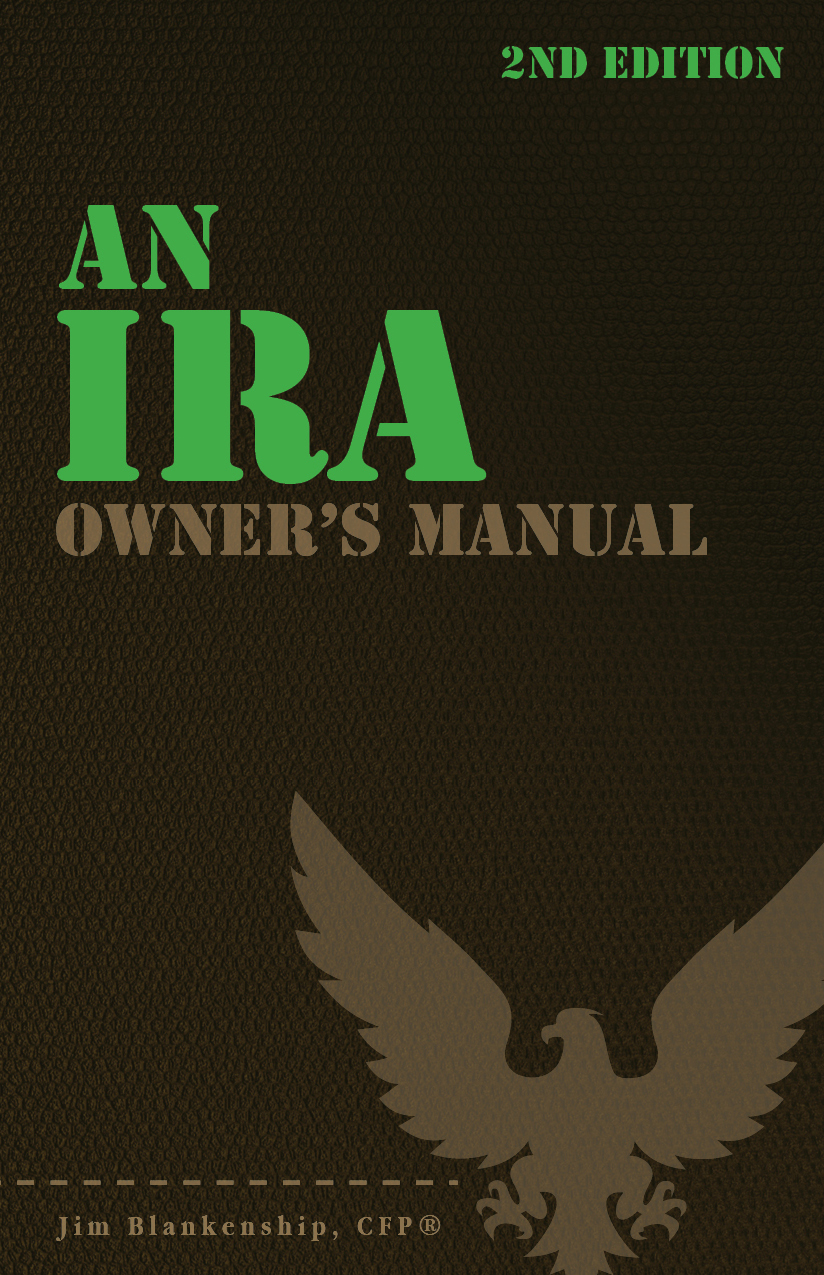 An IRA Owner’s Manual, 2nd Edition is available for purchase on Amazon. Click the link to choose the
  Jim’s book – A Social Security Owner’s Manual, is now available on Amazon. Click this link for the
  And if you’ve come here to learn about queuing waterfowl, I apologize for the confusion. You may want to discuss your question with Lester, my loyal watchduck and self-proclaimed “advisor’s advisor”.