
 When a worker is receiving retirement benefits and/or members of his family are also receiving benefits based upon the retirement benefits, such as via spousal benefits, benefits for children, or other family members benefits, there is a maximum amount of benefit that can be distributed in total. (There is a separate maximum benefit computation for disability benefits, which we’ll cover in another article.)
How the Family Maximum Benefit is Computed
When computing the Family Maximum Benefit (FMB), the Social Security Administration falls back to its old habits of using a very convoluted formula, similar to the formula for computing the Primary Insurance Amount (PIA). The formula starts with the PIA of the worker whose record is being used to provide these benefits. The PIA is then broken into four separate portions based upon Bend Points (these are not the same Bend Points as those used in determining the retirement benefit or PIA itself).
The Bend Points for FMB are based upon when they were first calculated in 1979. At that time, the Average Wage Index (AWI) was $9,779.44 for 1977 (remember, the AWI is always two years behind) – and for 2016 the AWI is $48,642.15. Dividing the 2016 AWI by the 1977 AWI gives us a factor of 4.9739 to compute the Bend Points for 2018.
The original Bend Points were: $230, $332, and $433. Multiplying these Bend Points by our factor of 4.9739 gives us Bend Points of $1,144, $1,651, and $2,154. These are rounded to the nearest dollar.
Computation for the Current Year
So here’s how we use those bend points to determine the FMB, for a worker who becomes age 62 or dies in 2018 before attaining age 62:
1) 150% of the first $1,144 of the PIA, plus
2) 272% of the amount between $1,144 and $1,651 of the PIA, plus
3) 134% of the amount between $1,651 and $2,154 of the PIA, plus
4) 175% of the amount above $2,154 of the PIA.
The total of the four amounts is then rounded to the next lower multiple of $.10 if it’s not already a multiple of $.10.
Here’s an example:
A worker age 62 with a PIA of $2,200 has a FMB calculated as follows:
1) 150% times $1,144 = $1,716
2) 272% times $507 ($1,651 minus $1,144) = $1,379.04
3) 134% times $503 ($2,154 minus $1,651) = $674.02
4) 175% times $46 ($2,200 minus $2,154) = $80.50
Adding these together ($1,716 + $1,379.04 + $674.02 + $80.50) equals $3,849.56, rounded down to a FMB of $3,849.50 for this particular worker in 2018.
Photo by eyeliam



 Sterling Raskie, MSFS, CFP®, ChFC®
 The latest in our Owner’s Manual series, A 401(k) Owner’s Manual, was published in January 2020 and is available on
  A Medicare Owner’s Manual, is updated with 2020 facts and figures. This manual is available on
  Social Security for the Suddenly Single can be found on Amazon at
  Sterling’s first book, Lose Weight Save Money, can be
  An IRA Owner’s Manual, 2nd Edition is available for purchase on Amazon. Click the link to choose the
 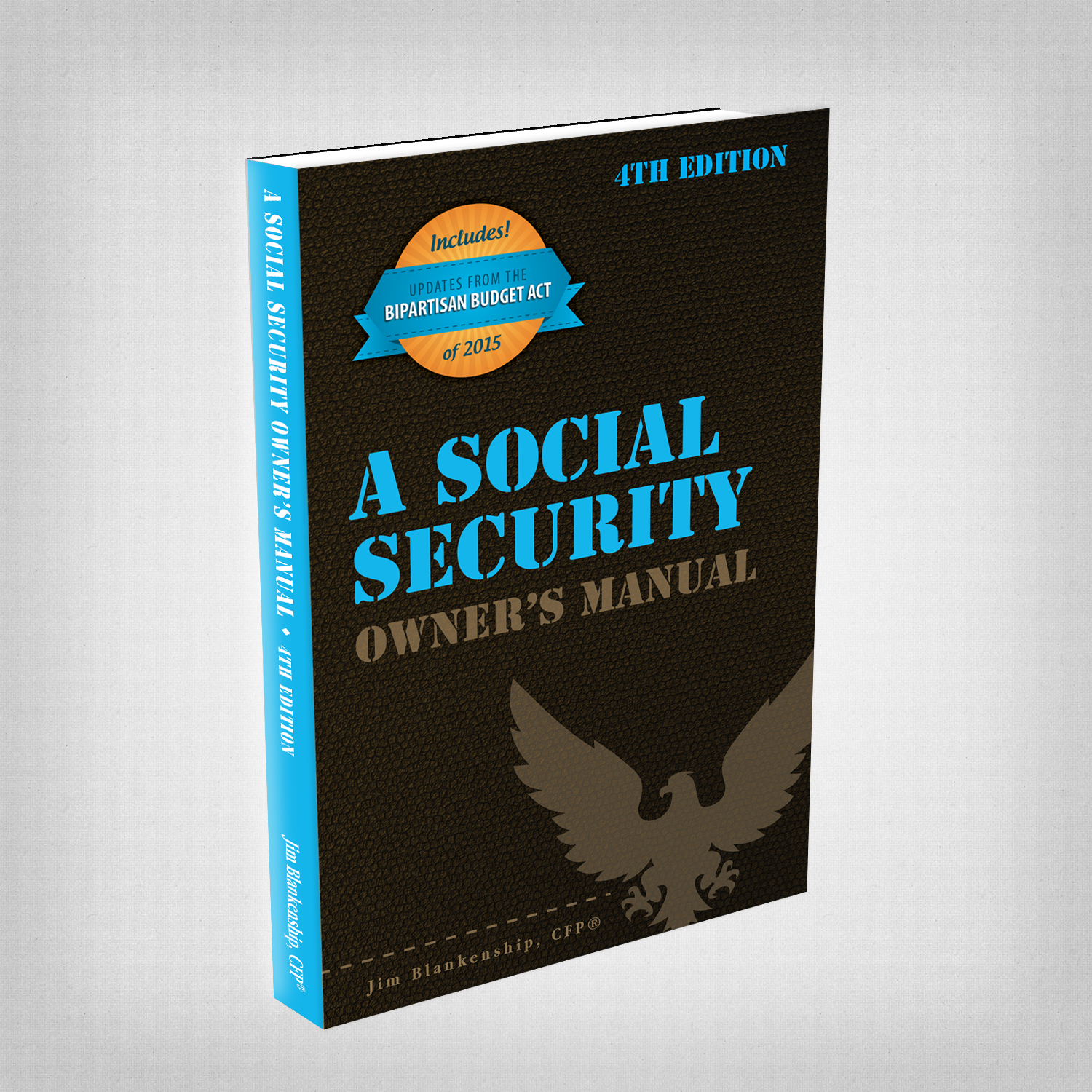 Jim’s book – A Social Security Owner’s Manual, is now available on Amazon. Click this link for the
  And if you’ve come here to learn about queuing waterfowl, I apologize for the confusion. You may want to discuss your question with Lester, my loyal watchduck and self-proclaimed “advisor’s advisor”.