
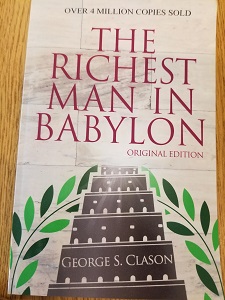
Photo credit: jb
The fifth part in our series of the lessons from George S. Clason’s bestseller The Richest Man in Babylon. If you’d like to go back to the beginning and catch up on the earlier lessons, you can start with the first article in the series by clicking this link.
The Gold Lender of Babylon
In this chapter (chapter 6 of the book) we learn a few valuable lessons about lending money. The story is about a young man named Rodan who came into some sudden unexpected money. As you might expect, his “friends” quickly multiplied and his family became bold in their requests for loans. And, not wishing to be foolish with his money (which amounted to what he could save otherwise in fifty years!), Rodan wisely seeks the counsel of the gold lender, Mathon, due to his long experience in loaning money successfully.
One of the first things that Mathon explains is how providing assistance to another should never result in your taking on the burden yourself. In other words, were Rodan to loan his money to someone who was incapable of repaying it, he would be taking on the burden of the lack of that money. The way to alleviate this is to require a borrower to provide some sort of collateral, something of value to the borrower, to secure the loan.
In some cases the collateral is of greater value than the loan – in those cases the money lender is virtually guaranteed of the return of the principal plus interest, or the collateral can be sold to make up the money loaned. In other cases there is the promise of wages to be earned – these are also very easily assured, for the most part. In yet other cases there is nothing of value that the borrower can deliver other than the assurance of his friends and family that the loan will be repaid (the modern-day co-signer).
Mathon provides Rodan with many examples of good and bad loans he’d made throughout the years, each with similar lessons. In the end, Rodan asks the real question that he came to ask: should he loan his “found” money to his sister’s husband in order to help him get started out as a jewel merchant?
Mathon asks some simple questions: What knowledge does the brother-in-law have of the ways of trade? Does he know where to buy at the lowest cost? Does he know where to sell at a fair price?
Rodan acknowledged that his brother-in-law did not possess the skills of a merchant. And so Mathon explained again that, while it is noble to lend a hand, it is critical to make certain that you are not taking on the burden for yourself. In the case of Rodan’s brother-in-law, the purpose of the loan would likely end up in failure due to the brother-in-law’s inexperience; thus transferring the lack of funds to Rodan.
Put succinctly, when loaning money you must always have a way to ensure that it will be returned to you with interest. Whether that is in the form of collateral, the borrower’s good reputation, or the assurance of a co-signer (possibly with collateral), you must always make sure it’s a given fact that your money will be returned once borrowed.
As the parting statement from the gold lender, Mathon shows Rodan his chest full of tokens used as collateral for loans… and inscribed on the lid, very succinctly, is our lesson:
Better a little caution than a great regret.
The next installment will cover The Walls of Babylon – with some insights regarding financial advisors and protection.



 Sterling Raskie, MSFS, CFP®, ChFC®
 The latest in our Owner’s Manual series, A 401(k) Owner’s Manual, was published in January 2020 and is available on
  A Medicare Owner’s Manual, is updated with 2020 facts and figures. This manual is available on
  Social Security for the Suddenly Single can be found on Amazon at
  Sterling’s first book, Lose Weight Save Money, can be
  An IRA Owner’s Manual, 2nd Edition is available for purchase on Amazon. Click the link to choose the
  Jim’s book – A Social Security Owner’s Manual, is now available on Amazon. Click this link for the
  And if you’ve come here to learn about queuing waterfowl, I apologize for the confusion. You may want to discuss your question with Lester, my loyal watchduck and self-proclaimed “advisor’s advisor”.